

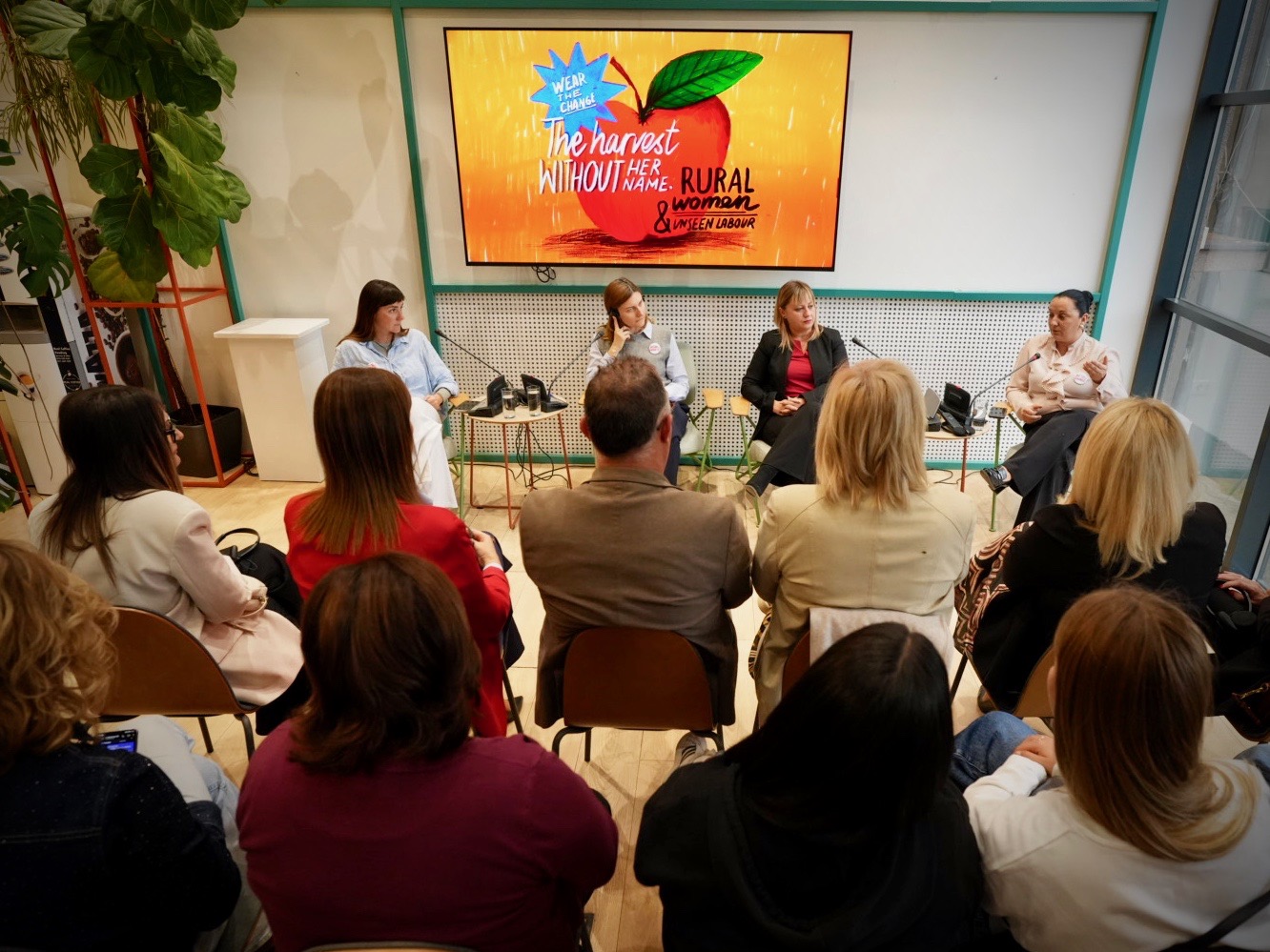
More than 38,000 women in North Macedonia are registered as farmers, yet many lack equal access to financial security, maternity leave, health insurance and social security protection. These challenges were at the heart of yesterday’s panel discussion, “The Harvest Without Her Name: Rural Women and Unseen Labour,” held at Europe House Strumica.
The event was organised as part of the “Wear the Change” campaign, launched by the Delegation of the European Union and EU Member State embassies united under #TeamEurope. The discussion provided a space to address systemic and institutional barriers, as well as the prejudices and inequalities that prevent rural women from fully exercising their rights.
Women farmers play a vital role in food production and the rural economy, while also bearing much of the responsibility for household and care work. Yet their labour and contributions often remain unrecognised within formal economic and institutional frameworks. Access to property and land is a particular concern: in 2021, only 4.1% of women in rural areas were registered as property owners, while women account for just 12% of landowners nationwide.
The discussion explored the reasons behind these inequalities, including inheritance practices. Although daughters have a legal right to inherit, they often give up their share in favour of their brothers. This is influenced by long-standing traditions and the expectation that, after marriage, a daughter will “belong to another family.”
The panel featured Veronica Ioana Ciolca, Deputy Head of Mission at the Embassy of Romania; Lejla Rajkova, an advocate for rural women’s rights and local agriculture; and Liljana Jonovski, an associate professor at the Faculty of Law in Kičevo and an expert on women’s participation in public life, with a focus on rural areas. The discussion was moderated by Andrea Ugrinovska of Tiiiit! Inc., Skopje.
The panellists examined the challenges faced by women living and working in rural areas, the implementation of existing laws and the support mechanisms available to them. They also discussed Romania’s experience as a country with a significant share of its workforce employed in agriculture, as well as the European Union’s role in advancing the rights of rural women.
The conversation also addressed the social and cultural barriers that persist despite existing legal protections, and explored how institutions and communities can help create equal opportunities. The audience joined the discussion during a question-and-answer session following the panel.
The central message was clear: the contributions of women farmers must be recognised and matched by equal rights and greater security. Ensuring access to property, health and social insurance, and employment-related rights is an important step towards a fairer and more sustainable society.
Through the “Wear the Change” campaign caravan, the Delegation of the European Union, EU Member State embassies and the Europe House network continue to encourage public conversations about gender equality and women’s rights across the country.